Arrived in Korea? 🇰🇷 The Ultimate Foreign Registration Guide for D-2 Students (2026 Edition)
Overview
Welcome to Korea! 🎉 Delicious Tteokbokki, a beautiful campus, and new friends… Are you excited about your new journey?
But wait! Just getting off the plane doesn’t mean you’re fully settled. There is one final gate you must pass to become a true “Resident of Korea”: Foreign Resident Registration.
As your seniors will tell you, “You can’t do anything without a Residence Card!” It’s true. Opening a bank account, getting a phone number, ordering food delivery, or even working a part-time job… None of this is possible without this card.
For the class of 2026, here is the fastest and easiest guide to navigating the complex Foreign Registration process.
1. Do I really need to do this? 🤔
Yes, absolutely!
According to the Ministry of Justice, any foreigner intending to stay in Korea for more than 90 days must register at the local Immigration Office within 90 days of arrival.
- Deadline: Within 90 days of entry (Fines apply if late 💸)
- Target: Holders of long-term visas like D-2 (Student) or D-4 (Language Trainee).
- Result: Foreign Resident Registration Card (Often called “ARC”, but the official name is now Residence Card).
2. When should I apply? (The Golden Time) ⏰
Thinking, “I have 90 days, I’ll take my time”? Big mistake!
February-March and August-September are the start of new semesters, meaning every international student in the country is rushing to the Immigration Office. If you check HiKorea right now, you’ll likely see that reservation slots are fully booked for the next month.
💡 Pro Tip: While some universities organize group applications, if you are applying individually, book your visit reservation immediately upon arrival! It takes another 3~4 weeks to receive the actual card after applying.
3. Required Documents Checklist ✅
Make sure you have everything before you go. Missing even one document means you’ll be sent home and have to make another reservation (waiting another month…).
- Passport (Original & Copy) (Profile page & Visa page)
- Color Photo (1 pc) (3.5cm x 4.5cm, White background)
- Warning: Do not use the same photo as your passport if your passport was issued more than 6 months ago.
- Certificate of Enrollment
- Get this from your university admin office or an automated issuing machine on campus.
- Proof of Residence
- Dormitory: Certificate of Dormitory Residence.
- Off-campus (Rent): Lease Agreement (If it’s not under your name, you need an additional “Confirmation of Residence/Accommodation” form).
- TB (Tuberculosis) Check Certificate (High-risk countries only) 🏥
- If you are from one of the countries below, you MUST get tested at a local Public Health Center (Bo-geon-so) serving your residence area. (Takes 3~4 days).
- [List of 35 High-Risk Countries]
Nepal, East Timor, Russia, Malaysia, Mongolia, Myanmar, Bangladesh, Vietnam, Thailand, Sri Lanka, Uzbekistan, India, Indonesia, China, Cambodia, Kyrgyzstan, Pakistan, Philippines, Laos, Kazakhstan, Tajikistan, Ukraine, Azerbaijan, Belarus, Republic of Moldova, Nigeria, South Africa, Ethiopia, Kenya, DRC, Mozambique, Zimbabwe, Angola, Peru, Papua New Guinea
- Fee (Cash 35,000 KRW + Delivery fee) 💸
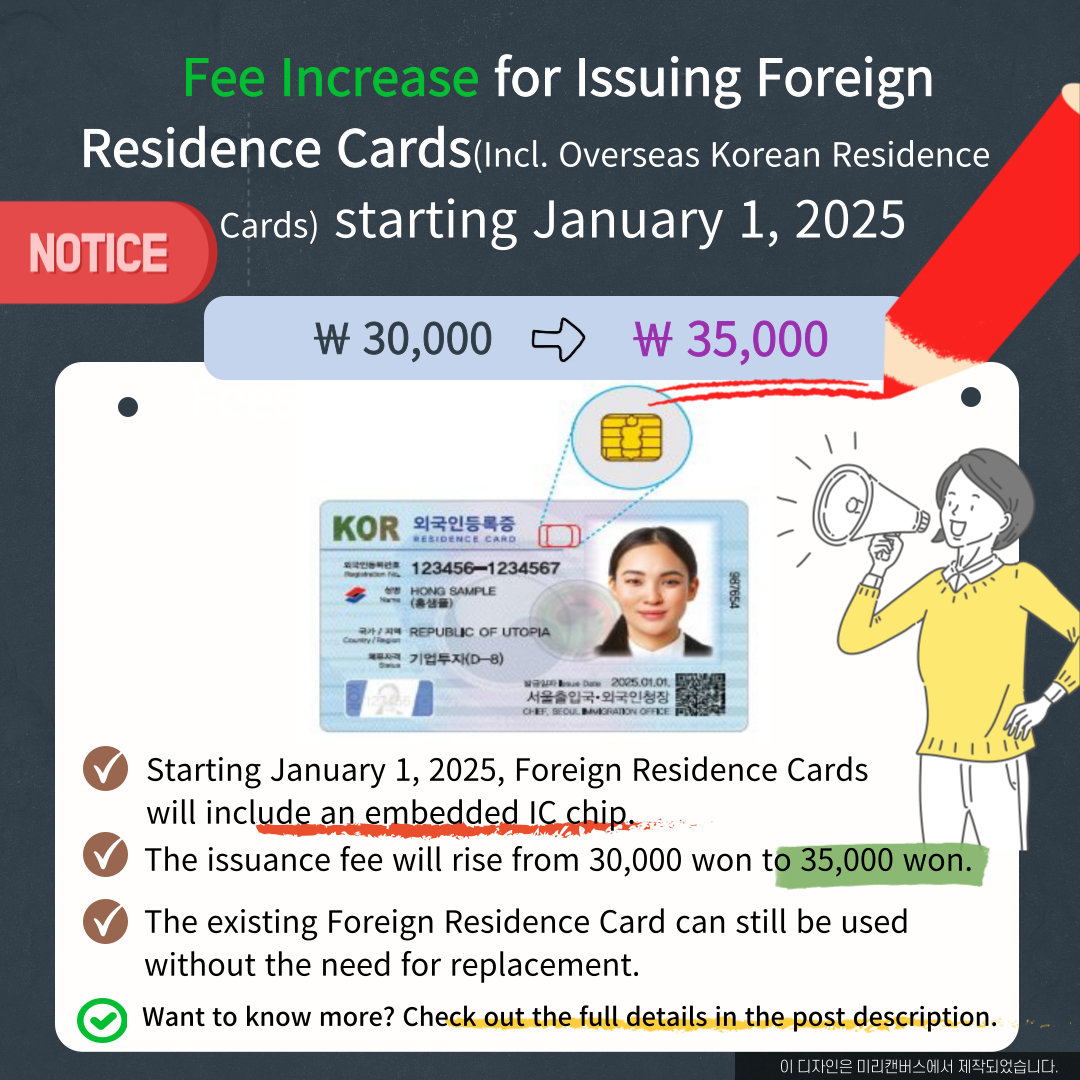
- Issuance Fee: As of Jan 1, 2025, the fee increased to 35,000 KRW (due to the new IC chip cards).
- Delivery: If you want the card mailed to you (saving a second trip), bring an extra 4,000~5,000 KRW in cash.
- Integrated Application Form 📝
- This is the most critical document and where most mistakes happen!
4. How to Finish the Application Form in 3 Minutes 🚀
If you visit the Immigration Office, you’ll see students sweating in the corner, frantically writing their forms. Using Korean addresses is hard enough, but the real nightmare is the ‘Home Country Address’.
“How do I write my Vietnamese address in English?” “What is the correct order? District-Street-Number?”
Many applications get rejected at the counter because of these errors. Stop worrying and use the K-Visa Application Helper.
Why use [K-Visa]?
- ✍️ No Handwriting: Type on your PC or mobile to generate a perfectly clean PDF.
- 🌏➡️🇺🇸 Auto-Translation of Home Address: No need for Google Translate. Enter your address in your native language (Chinese, Vietnamese, etc.), and it automatically converts it to the standard English format. (This is a game-changer!)
- 🛡️ Error Prevention: Automatically checks for missing fields and correct formatting.
👉 Create Your Form Now (Only $3) (Save yourself the headache for just the price of a coffee ($3). Finish it in 3 minutes.)
5. The Process (Step-by-Step) 👣
- Reserve Visit: Go to
hikorea.go.kr-> Reserve a Visit (Non-members allowed). - Prepare Docs: Gather all items in the checklist above. (Print your application form in advance!)
- Visit Office: Arrive 10 minutes early. Go to the counter when your number is called.
- Fingerprints: Scan fingerprints of both hands and take a digital photo.
- Get Receipt: Receive a receipt telling you when to pick up your card. (Keep this safe!)
6. FAQ 🙋♀️
Q. Can I open a bank account before I get my Residence Card? A. Some banks might allow a restricted account (with transaction limits) using just your Passport + Certificate of Admission, but most will require the Residence Card.
Q. What if I move to a new house? A. You MUST report your change of residence within 14 days of moving. You can do this at the local community center (Dong-office) or online at HiKorea. (Failure to do so results in heavy fines!)
Q. When can I start a part-time job? A. You can legally work only after receiving your Residence Card AND getting ‘Permission for Part-time Work’ from immigration (with your professor’s sign-off). (For D-2, usually allowed after 6 months, but rules vary by GPA and Korean proficiency).
Foreign Resident Registration is the first button you button up in your Korean life. It looks complicated, but if you prepare your documents carefully, it’s a breeze.
Don’t let the English address translation stress you out—let K-Visa handle it. Imagine the immigration officer saying, “Wow, your documents are perfect!” 😉
Good luck with your studies and life in Korea! 🇰🇷✨